

How can you tell if your company is the target of a cyberattack? For many managers of very small or small/medium businesses, this question can seem abstract until you have faced an IT incident. Yet cyberattacks no longer target only large companies. Quite the opposite: small organisations have become prime targets, often through lack of protection or vigilance.
This first article in a series of three helps you take an essential first step in protecting your business: knowing how to spot the warning signs of an attack, understanding the main threats and above all, reacting effectively from the very first seconds.
Recognising the signs of a cyberattack
Cybercriminals don’t always strike loudly. Some attacks manifest very discreetly. Others, on the contrary, cause an abrupt interruption of your activities. In every case, the earlier you identify the symptoms, the more you limit the damage.
Common symptoms of a cyberattack
Imagine opening your computer at the office one morning and finding all your files suddenly inaccessible, replaced by a worrying message demanding money. Or your mailbox filling up with error messages, indicating that you have sent dozens of emails you never wrote…
This kind of situation is not a science-fiction scenario. These are classic symptoms of a cyberattack.
The first signs can vary. Among the most common are:
- An unusual slowness of the network or computers, not explained by normal load.
- Abnormal behaviour such as files disappearing, being renamed or difficult to open.
- Passwords that no longer work, or unexpected reset requests.
- Strange pop-ups or suspicious messages.
- Being unable to access certain usual services (mailbox, CRM, invoicing…).
In a small accounting firm, for example, an employee notices that their password no longer works. They try a reset, without success. Shortly afterwards, the firm’s email system sends a series of emails with malicious attachments. This situation is typical of a hacked email account, often used as an entry point to other company systems.
Common categories of attacks
In the digital world, not all attacks look alike. Some are noisy, visible, and leave little doubt about their nature. Others, on the contrary, are discreet, almost invisible, and creep into your IT systems for weeks before acting. To defend yourself, it is therefore essential to understand what types of attacks can target a company like yours.
The best-known threat, and also one of the most feared, is ransomware.
In this scenario, malicious software enters your computers and encrypts all your files, making them completely inaccessible. A message then appears, asking you to pay a ransom, often in cryptocurrency, in the hope of recovering your data.
Another type of attack, subtler but just as frequent, is phishing.
It is often a fraudulent email imitating the appearance of an official message, a supplier, a public service or even a colleague, to get you to click on a link or provide sensitive information.
There are also attacks that do not directly target your files, but your IT infrastructure. This is the case with denial-of-service attacks, called DDoS. Here, the aim is to saturate your website or servers with a huge number of requests until they go down.
Some attacks go through technical flaws.
Software that has not been updated, a default password never changed, or a poor network configuration can give cybercriminals an entry point. They can then infiltrate silently and, in some cases, stay in your systems for weeks without being detected.
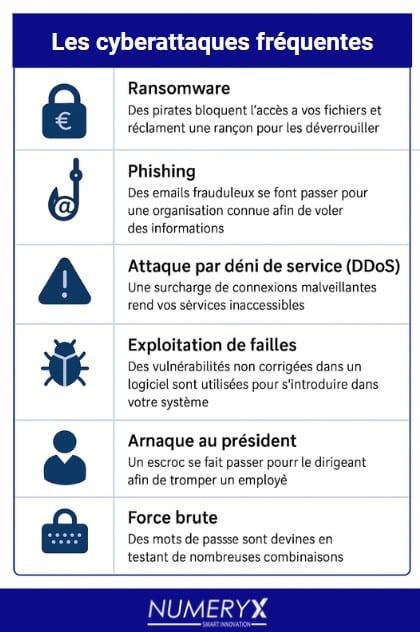
Also, the CEO fraud is a technique increasingly used in small organisations.
The principle is simple: a hacker poses as the company’s manager and asks an employee to make an “urgent” transfer to a bank account. Playing on pressure and hierarchy, this type of attack can cost a company thousands of euros in minutes.
Finally, some attacks target weak or reused passwords.
Using automated tools, cybercriminals test thousands of combinations until they find the right one. Once the right password is found, they can log in to your business accounts as if they were you.
All these attacks have one thing in common: they seek to exploit the most accessible flaw in your organisation, whether technical or human. And it is often in small organisations, less prepared, that they find their way most easily.
What to do immediately if you suspect an attack?
Let’s take a concrete example: you notice a spike in network slowness, accompanied by several strange error messages. One of your colleagues tells you they can no longer access their files. You suspect an attack. What should you do?
First of all, stay calm, because every action can have significant consequences.
First step: immediately disconnect suspicious devices from the Internet or the local network. This helps limit the spread of malicious software, particularly in the case of ransomware.
Then, warn the other members of the team internally to prevent another workstation from being infected or an employee from opening a suspicious link. If you work with an IT provider or managed services provider, contact them immediately. They can start the first checks and advise you on what to do.
Don’t delete anything in a rush: evidence is essential to understand what happened and respond effectively.
If you have no IT department or cybersecurity lead, it is strongly advised to call on a specialised provider. Companies such as NUMERYX, experts in cybersecurity for SMEs, can support you urgently to diagnose the attack, limit the damage and prepare corrective actions.
In short
Recognising a cyberattack is not always obvious for a very small or small/medium business, especially if the company has never put specific protections in place. Yet knowing how to identify weak signals, understanding cybercriminals’ methods and knowing how to react in case of doubt is an important first level of defence.
Every day, companies of all sizes are targeted. Those that manage to react quickly and effectively are also those that took the trouble to train and prepare in advance. This first article helps you lay the foundations.
In the second article in this series, we will see how to react concretely when an attack is confirmed. From setting up a crisis cell to communicating with stakeholders, you will learn how to structure your response, even without being an expert.
Read next: Putting an emergency plan in place to face a cyberattack


