
At NUMERYX, our commitment to Corporate Social and Environmental Responsibility (CSR) is at the heart of our strategy.
In an ever-changing world, it has become essential for companies to play an active role in building a better future.
We sincerely believe in this principle and are proud to take a responsible approach to our business. CSR is not just an obligation; it is an extraordinary opportunity to contribute positively to society, to our environment and to the lives of our employees

Want to support us in our CSR approach?

Companies, associations, foundations, public actors: shall we share our initiatives and actions together?
Ethics, the environment and social responsibility are the fundamental pillars that guide each of our actions and decisions, reflecting our commitment to leave a positive footprint for future generations.
Want to know more about our CSR approach?
Discover and download all of our charters and commitments.
Integrating CSR at NUMERYX means staying true to our values and to our vision of a responsible and ethical company. It means building strong relationships with our clients, establishing trust and favoring transparency at every step. We want a pragmatic and concrete approach to CSR. We explore opportunities and challenges while aiming for impactful and positive results for our society, working hand in hand with our clients, our service providers, our partners and all of our employees. This is why NUMERYX has joined the United Nations Global Compact.

A CSR approach involves putting in place specific actions and tools that touch all aspects of the company’s business and involve economic, social and environmental issues, as well as governance and stakeholder issues. Discover all the CSR initiatives put in place by NUMERYX

On the occasion of the back-to-school season, NUMERYX Tunisia renewed its commitment to education through two solidarity initiatives carried out with pupils of the Muthul school in Jendouba and the Souk Laachech school in Sfax.
These initiatives helped prepare the new school year by providing school supplies to pupils, supporting them in their new school year and allowing them to start off in better conditions.
Concrete actions serving education
Beyond the material contribution, these actions were an opportunity for the NUMERYX teams to share moments of closeness, exchange and conviviality with the pupils and the people involved in these initiatives.

The smiles, the conversations and the moments of sharing experienced during these encounters gave full meaning to our commitment and illustrate the importance we place on concrete, meaningful CSR actions.


A collective mobilisation
The success of these initiatives also relies on the mobilisation and involvement of our employees, who contributed to their organisation and delivery.


At NUMERYX, we are convinced that social responsibility takes on its full meaning when it translates into concrete, collective and lasting actions.
Through our commitment to education, we aim to contribute, on our scale, to giving children better conditions to learn, grow and build their future.
Because every gesture counts, every action can help make a difference.

Through two actions carried out in Sfax and Siliana, Numeryx supports children and promotes education, solidarity and positive social impact.
A back-to-school solidarity action in Sfax 🎒
At Numeryx, we put people at the heart of our CSR approach. For the start of the school year, we organised an action in Sfax to support children in the region.
Thanks to this initiative, school supplies were distributed to give them the best conditions to begin the school year.






A touching action in Siliana ❤️
Our commitment also took shape in Siliana, where we shared a memorable moment with the children of the region.
The action was marked by an atmosphere of friendliness and solidarity, creating moments rich in emotion and human closeness.
Beyond the help provided, it was above all the exchange and sharing that gave this initiative its full value.





Numeryx and social responsibility 🌍
These two actions reflect our vision of corporate social responsibility (CSR):
- Supporting education,
- Encouraging solidarity,
- Strengthening ties with local communities.
It is through simple gestures that we build a fairer, more united future.

As part of its CSR approach, NUMERYX is proud to announce its participation in the Solidarity Bottle Cap Collection Campaign, a citizen initiative launched by the EMEL Tounes association. This campaign aims to help Tunisian citizens living with disabilities and in precarious situations, while promoting simple but meaningful actions.
A double impact: social and environmental
Through this action, NUMERYX wishes to:
- Encourage recycling for a solidarity cause,
- Actively contribute to the inclusion of people with disabilities,
- Involve its employees in a collective, responsible initiative.
Collection points set up in our offices
Dedicated spaces have been set up throughout our premises to make collecting plastic bottle caps easier. All employees are invited to take part. Because yes, every cap counts! The caps will then be collected by the association and turned into funds used to finance specialised equipment and support families in need.
An approach consistent with our values
At NUMERYX, we firmly believe that corporate social responsibility must translate into concrete, ongoing actions. This campaign embodies our values of solidarity, inclusion and environmental commitment.
We warmly thank the EMEL Tounes association for this wonderful initiative and are happy to support a cause that is close to our hearts.
Together, let’s collect the caps… and break down barriers!
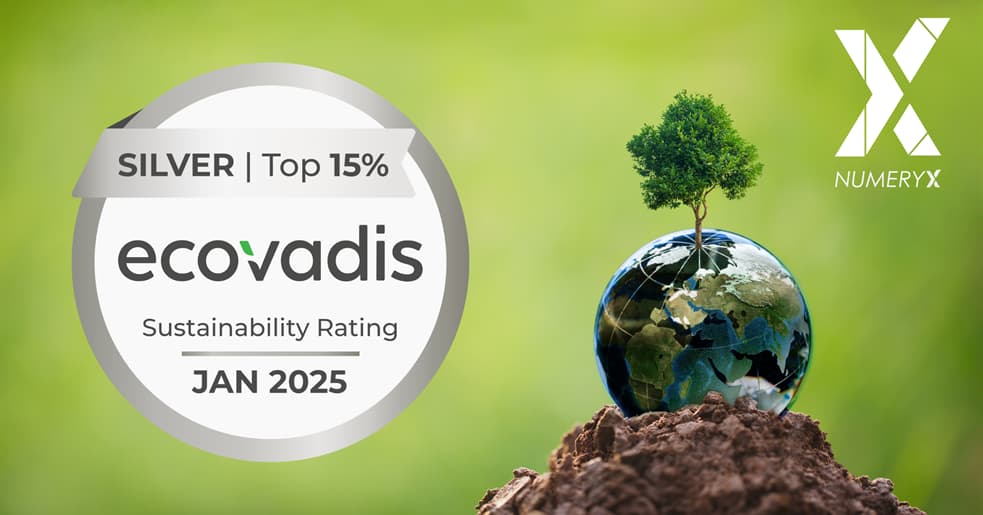
We are pleased to announce excellent news: Numeryx Technologies has obtained the silver medal in the ECOVADIS assessment!
This result crowns our CSR efforts and places our company among the top 15% of companies assessed by ECOVADIS over the past 12 months (85th percentile+).
In December 2023, just one year ago, we obtained the EcoVadis bronze medal, which reflects our constant commitment to CSR, and also the major place CSR holds in our group.
We would like to thank each of you for your contribution to this collective success. This progress reflects everyone’s commitment to our sustainable initiatives, and we look forward to continuing on this path to reach new goals.
In addition, to celebrate the success of this assessment, EcoVadis has decided to plant a tree in our name, as part of its partnership with the organisation One Tree Planted.
It is an excellent way for all of us to start 2025!

Fires, floods, food insecurity and population displacement… increasingly frequent and intense climate disruptions show just how pressing environmental and social issues are becoming. Faced with these issues, Corporate Social Responsibility (CSR) proves to be much more than a simple element of company life. It is now an unavoidable strategic and ethical requirement.
Engaging your company in a CSR approach is no longer just a moral decision, but a necessity that can have a considerable impact on society.
In this article, we will examine the reasons why your company must commit to CSR now and the benefits it can gain from it.
- What is CSR?
According to the European Commission’s definition, CSR is “the voluntary integration by companies of social and environmental concerns into their business operations and their relations with stakeholders”.
This means that companies are no longer content with pursuing profitability goals, but also seek to have a positive impact on society and the environment.
In practice, this involves taking into account the effects of their activities on the environment, promoting employee well-being, respecting local communities, providing quality products and services, and communicating transparently with stakeholders.
In other words, CSR is a global approach that aims to create value not only for the company itself, but also for society as a whole.
So what are the benefits a company can gain from a well-implemented CSR strategy?
- The benefits of a CSR strategy
A lever for competitiveness, differentiation and innovation
Corporate Social Responsibility (CSR) encourages companies to innovate in order to fully involve their employees, minimize their environmental impact and invest responsibly.
Companies that adopt an innovative approach to CSR can notably mitigate various risks, such as risks related to reputation, recruitment, waste or accidents.
CSR is in fact a performance driver that fosters more sustainable and healthier development. According to a France Stratégie study, companies that adopt CSR practices are 13% more efficient than others. By improving well-being at work, companies can indirectly increase their productivity. Indeed, satisfied employees are more likely to stay with the company in the long term and to work more effectively.
Companies that adopt sustainable practices can also achieve significant savings. For example, adopting cleaner technologies or reducing the consumption of natural resources can lead to significant savings in terms of energy, water and raw materials. However, this improvement in resource use may require an investment phase (new fleet of clean vehicles, electrical installation changes, sorting bins…) which is often supported by aid (regional, government, private…) and which over time allows significant savings.
This resource optimization not only improves operational efficiency, but also reduces the company’s dependence on finite resources, often subject to increasing volatility on the global market.
Moreover, a well-crafted corporate social responsibility strategy allows companies to stand out from their competitors on the market. Consumers are increasingly aware of the environmental and social impact of their purchasing decisions. A company’s ethical reputation is therefore paramount to them and they often favor those that adopt sustainable practices. In this way, a brand that demonstrates a genuine commitment to corporate social responsibility can stand out from the competition and retain a clientele that is vigilant about social and environmental issues.
In addition, CSR fosters innovation by encouraging companies to review their business strategies and to design innovative products and services that meet society’s emerging needs. These ambitious, CSR-focused companies stand out for their ability to take the lead on the latest technological advances and to explore sustainable solutions. Thanks to their strategic positioning, they are able to anticipate emerging market trends regarding sustainable development, which allows them to seize lucrative opportunities while asserting their leadership in a lasting way.
A major asset for strengthening relations with stakeholders
CSR goes far beyond mere communication or regulatory compliance for companies. It represents an effective way to strengthen ties with their stakeholders, whether internal or external.
At the heart of the company’s strategy, CSR puts forward dialogue with stakeholders. Thanks to this inclusive approach, it is possible to better understand and meet the expectations of each group:
Customers
By integrating environmental and social concerns into its products and services, the company meets consumers’ growing expectations regarding sustainability. By adopting transparent and responsible practices, the company demonstrates its commitment to the well-being of society and the environment. This can translate into increased customer loyalty, an improved brand image, and reduced reputational risks.
What is true in B2C is also true in B2B. Purchasing departments are increasingly scrutinizing companies’ CSR trajectory, and some even make it a selection criterion in their calls for tender.
Employees
CSR policies foster employee engagement and retention, as they feel more involved in a company aligned with their values. By promoting values such as fairness, respect for human rights, and diversity, companies create an environment conducive to the motivation and fulfillment of their employees. Teams are thus more invested in the company’s success, which translates into increased productivity, greater talent retention, and reduced absenteeism.
Suppliers / partners
Implementing ethical practices in the supply chain can certainly strengthen collaboration and mutual trust.
Thus, companies encourage their suppliers to improve their own environmental and social management practices by demanding high standards from them. This can include elements such as reducing carbon emissions, respecting employee rights, fighting corruption, and promoting safe and fair working conditions. Updating practices has a positive impact on the entire value chain, thus fostering more sustainable and equitable development. This can also be driven by customers. Indeed, customers are keen for the entire value chain to be affected by the CSR approach, and suppliers / partners are an integral part of this value chain.
Local communities (Administrations, associations…)
CSR actions can help build closer ties with the areas where the company operates.
Companies have the opportunity to partner with local associations and NGOs in order to support particular social and environmental causes. The closer they are, the more sense it makes. By working closely with local players, companies have the opportunity to take part in projects that affect them and directly affect the ecosystem. CSR is then concrete and not simply an intangible vision. These partnerships also make it possible to optimize the effect of corporate social responsibility initiatives by bringing together the diverse resources and skills within the organization.
A powerful lever for improving reputation and brand image
A clearly defined and implemented corporate social responsibility policy can change the public perception of a company, strengthen the trust of consumers and stakeholders, and ultimately lead to greater loyalty and greater attractiveness. Crédit Mutuel can be taken as an example. The bank is a real success in terms of CSR, which forms a true backbone for this financial institution. As proof, the bank has regularly ranked first in its sector (YouGov barometer) for companies with strong CSR value.
According to a European study on responsible consumption carried out by Oney in 2020/2021, 90% of consumers expect brands to commit and help them consume better. By meeting these expectations, a company can not only improve its reputation but also position itself as a leader in its sector.
Consumer loyalty to a brand that shares their values and demonstrates a concrete commitment to societal and environmental causes is often higher. According to the Earned Brand 2018 study conducted by Edelman, 65% of French people choose to buy (or boycott) a brand based on its position. By incorporating corporate social responsibility measures into its strategy, a company can not only attract new customers, but also strengthen the loyalty of its existing clientele. Loyal customers turn into brand ambassadors, which fosters a better reputation and increased visibility.
A powerful tool for attracting talent
The employer brand is the perception that employees and candidates have of a company. It encompasses all the values, corporate culture and career progression opportunities a company offers its employees. It is of paramount importance for attracting and retaining talent, as well as for strengthening employee engagement. CSR can play a key role in creating this image.
According to a 2023 OpinionWay study, 77% of employees and 83% of HR managers consider that a company’s CSR commitments work in favor of its attractiveness. This trend is confirmed with 76% of HR and 69% of employees who see CSR policy as a criterion for applying to or staying with the company.
This growing concern for CSR is particularly marked among younger generations, especially Millennials and Generation Z, who place great importance on the values and societal impact of the companies they wish to work for.
Candidates seek to strike a balance between their personal values and those of their employer. A company that adopts a sincere and ambitious CSR approach fosters this alignment of values by meeting this quest for meaning at work and the desire to contribute positively to society.
However, despite these growing expectations, 47% of human resources managers acknowledge not highlighting their corporate social responsibility policy in their job offers, which is a missed opportunity.
Ultimately, a good employer brand and a consistent CSR policy make it possible to stand out from other companies, but it is important to truly embody these commitments and to involve employees in all stages of developing the company’s CSR strategy.
Despite the many benefits it presents, implementing a CSR strategy is not free of significant challenges, which requires a proactive approach to ensure effective and lasting integration into the company’s operations.
- The challenges of CSR: How to overcome them to succeed?
Implementing a Corporate Social Responsibility (CSR) approach can pose significant challenges. These notably include changing mindsets within the company, mobilizing financial and human resources, and ensuring total transparency. It is essential to adopt an organized and proactive approach in order to overcome these obstacles.
a. Raise awareness and train
Employees may be reluctant to adopt new practices, especially if they involve significant changes to their daily routines. Awareness-raising and training play a central role in the success of this transition. Through employee involvement and training, it is possible to develop a corporate culture based on values of responsibility and sustainability. Whether it takes the form of workshops, seminars or communication campaigns, a pragmatic approach that suits your company must be adopted, otherwise you risk giving the impression of “greenwashing”.
Employees may also lack the skills needed to implement CSR initiatives effectively. Offering continuing training programs makes it possible to develop the skills needed to implement CSR initiatives. These trainings can cover topics such as waste management, energy efficiency, ethical work practices… More specific training can also be offered to managers to help them integrate CSR into their management practices.
It is equally important to highlight leading by example at management level. It is essential that leaders embody the company’s CSR values and encourage their teams to adopt this approach.
b. Set clear and measurable objectives
Defining clear and measurable objectives is one of the pivotal points in implementing a CSR strategy. This not only provides direction for the company’s actions, but also progress tracking and a clear direction to follow based on the results obtained. Poorly defined objectives can undermine the assessment of progress and the achievement of desired results.
Objectives must be specific, measurable, achievable, relevant and time-bound (SMART). For example, instead of setting a general objective such as “reduce carbon emissions”, a SMART objective would be “reduce carbon emissions by 20% by 2025 compared to 2020 levels”.
Next, they must also be aligned with the company’s business and strategic objectives for effective integration into the company’s overall strategy and to ensure their relevance and real impact.
CSR objectives must reflect the expectations and concerns of all stakeholders, both internal and external.
It is also important to define key performance indicators (KPIs) for each CSR objective. These KPIs must be quantifiable and allow progress to be tracked on a regular basis. For example, for a waste reduction objective, a relevant KPI could be the percentage of recycled waste relative to the total waste produced.
Finally, we must not forget to set up regular monitoring and transparent, widely shared reports on progress, in order to maintain engagement and demonstrate progression.
c. Have transparent and regular communication
Poor communication, or the absence of communication, can harm the perception of and buy-in to the company’s initiatives. It is therefore essential to maintain clear and consistent communication. This involves openly sharing the successes, challenges and progress of CSR actions through a variety of channels.
Using channels such as annual reports, websites, social networks and public events makes it possible to reach a wider audience and demonstrate the company’s commitment in a credible and authentic way.
Let’s not forget internal communication, using newsletters, intranets, and team meetings to share the objectives, progress and results of CSR initiatives. Communication must be two-way, allowing employees to ask questions and give their feedback.
It is also crucial to be transparent in handling challenges and failures. By acknowledging the obstacles encountered and explaining the actions taken to overcome them, the company strengthens its credibility and demonstrates a genuine commitment to continuous improvement.
d. Collaborate with external partners
Companies may not have the funds necessary to hire CSR experts or to finance this type of project. Collaborating with non-profit organizations, local players, NGOs or other companies can make it possible to share costs, resources, knowledge and best practices, while maximizing the impact of CSR initiatives.
Collaborations with external partners facilitate mutual learning and make it possible to benefit from the expertise and support of other organizations engaged in similar approaches.
These partnerships can take various forms, ranging from co-creating projects to participating in sector-wide initiatives, including mentoring programs or exchanges of best practices.
Ultimately, thanks to external collaboration in CSR, companies can go beyond their individual limits and make a significant contribution to broader sustainable development goals. As the saying goes, “alone we go faster; together we go further”
e. Integrate ESG criteria for a more robust CSR
ESG is an acronym for (Environmental, Social and Governance). It refers to the non-financial dimensions used to measure and monitor the impact of a company or organization on the environment, the economy and society.
According to the definition of the Autorité des marchés financiers (AMF), these non-financial criteria “make it possible to assess an economic player apart from the usual financial criteria such as profitability, share price and growth prospects.”
Thus, they represent a relevant and effective tool for assessing companies’ CSR policy by examining how they integrate sustainable development into their activities and by evaluating their impact on society.
Integrating ESG criteria represents a significant and essential challenge for strengthening and effectively measuring CSR initiatives. This approach makes it possible to move from a qualitative approach to a more quantitative assessment of sustainable development.
For the environmental criterion, companies must for example assess their waste management, their greenhouse gas emissions and their energy consumption. The social criterion involves analyzing respect for employee rights, gender parity, the prevention of workplace accidents and relations with local communities. As for the governance criterion, it encompasses the fight against corruption, transparency on executive pay and the independence of the board of directors.
To meet this challenge, it is essential that companies adopt recognized ESG reporting frameworks, implement robust data collection and analysis systems, train their teams on the importance and application of ESG criteria, and communicate transparently on their results.
f. The challenge of certifications
A major challenge for companies engaged in a CSR approach is obtaining recognized certifications such as EcoVadis or B Corp.
These rating schemes play an essential role in confirming the effective implementation of a corporate social responsibility strategy and in providing credible external recognition.
However, the certification process is itself a major challenge. It requires an enormous investment of time and resources, extensive data collection and often a reorganization of internal processes in order to satisfy the rigorous evaluation criteria.
For example, the EcoVadis assessment examines in detail the company’s policies, actions and results in four key areas: environment, labor and human rights, ethics and sustainable procurement. Similarly, B Corp certification involves a rigorous assessment of the company’s overall impact on its workers, customers, community and environment. To overcome this challenge, companies must adopt a strategic approach. This begins with a good knowledge of the evaluation criteria specific to each system, and then incorporating them into the company’s overall strategy afterwards. It is also crucial to set up a robust data collection and analysis system, while training employees on CSR issues and certification requirements. The use of specialized reporting tools, regular sector benchmarking, and the active involvement of general management are also very important. Finally, transparent communication through detailed sustainability reports and collaboration with external experts are common practices to improve CSR performance and effectively meet the requirements of recognized rating systems.
In summary, involvement in Corporate Social Responsibility (CSR) is no longer an option, but an absolute necessity for any company that wants to thrive in today’s and tomorrow’s world.
Engaging in a corporate social responsibility approach is not limited to a moral decision. It is an essential strategy that offers important benefits, such as improved competitiveness and innovation, strengthened relations with stakeholders and an improved reputation and brand image for the company.
So why wait? The time has come to take action. Every step toward a more integrated CSR approach is a step toward a more sustainable and prosperous future. Whether you are a large company or an SME, the benefits of CSR are within your reach.
Remember: CSR is not a destination, but a continuous journey of improvement and adaptation. By starting today, you not only ensure the longevity of your company, but you also help shape a better world for future generations.
As a committed company, we fully recognize our responsibility. This is why we are putting concrete measures in place to minimize our environmental impact and help create a sustainable future.
Numeryx Technologies has been awarded the silver medal in the ECOVADIS assessment. This result crowns our CSR efforts and places our company among the top 15% of companies assessed by ECOVADIS over the last 12 months (85th percentile+).
represents the percentage of our suppliers that are certified, labeled and committed to environmental initiatives in 2023. Our goal, of course, is for 100% of our partners to be engaged in an eco-responsible approach.
is the number of schoolchildren we were able to support and equip thanks to the generosity and commitment of our employees, alongside associations working for education and access to schooling in socially and economically disadvantaged areas.
Want to support us in our CSR approach?
Companies, associations, foundations, public actors: shall we share our initiatives and actions together?