

Lately, all eyes have been on SD-WAN. It is becoming for networks what the Cloud has become for infrastructures and applications. Yet, although the concept of a software-defined wide area network (SD-WAN: Software Defined Wide Area Network) is generally understood, it is often confused with its technological parent, the software-defined network (SDN: Software Defined Network).
So to what extent can these technologies be so alike and yet so different?
SDN and SD-WAN, almost identical twins:
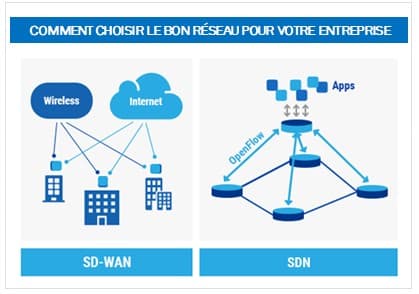
SDN and SD-WAN are based on the same methodology of separating the control plane from the data plane to make the network smarter. Like identical twins, they may look alike, but they are quite different from each other. The main difference between SDN and SD-WAN lies in their use.
While SDN meets the modern networking needs of managing local area networks (LAN) or carriers’ core networks, SD-WAN is used to connect geographically distributed locations and remote users. SDN and SD-WAN can be virtualized to implement additional virtual network functions (VNF) such as security capabilities and WAN optimization. .
The distinctions between SDN and SD-WAN
SDN is fully programmable by the customer or user and allows efficient management of changes and configuration. While SD-WAN is built on SDN technology, the programming is handled in the background by the SD-WAN provider, thus eliminating the complexity for the end user.
SDN focuses on the internal network, whether it is the local network or the core network of service providers, while SD-WAN focuses on enabling connections between networks and users over the WAN.
SDN is enabled by NFV (Network Function Virtualization), providing several network functions virtualized through software that was previously embedded in closed proprietary systems. In contrast, SD-WAN provides software-defined application routing that can be virtualized and run either virtually or on an SD-WAN appliance.
| Software Defined Network (SDN) | Software Defined WAN (SD-WAN) |
| Manages a local network or a service provider’s core network | Enables connections between networks and users across geographic areas |
| User-programmable to provide bandwidth on demand | Programmable to provide operational simplification, integrated security and traffic prioritization |
| Similarity of separation of the control plane and the data plane | Similarity of separation of the control plane and the data plane |
| Offers visibility into core network performance and real-time analytics | Offers visibility into the WAN environment and real-time analytics |
| Provides a centralized view for network service automation | Focuses on software-defined application routing capabilities |
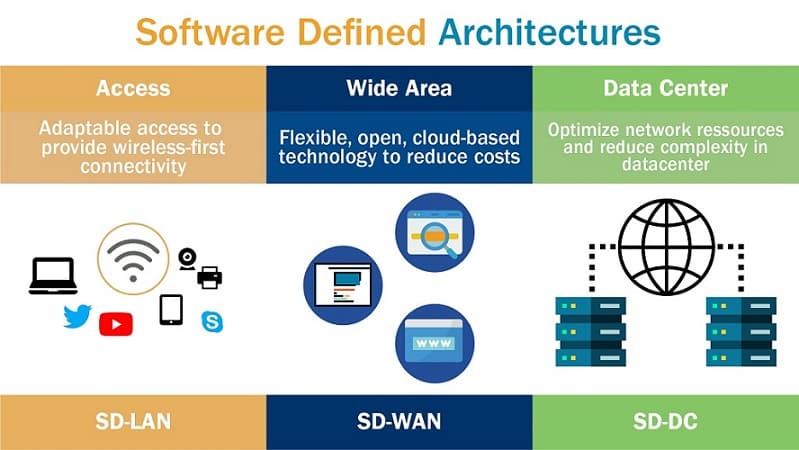
SD-WAN takes you from the world of packets to that of applications and beyond
The technology behind SD-WAN changes the paradigm from a packet-based network routing system to an application-based routing system. This allows organizations to use consumer broadband Internet with improved quality and performance, and above all, a lower cost per megabyte than was previously available with MPLS.
SD-WAN also offers agility and flexibility, while maintaining centralized predefined corporate policies controlling how applications are routed. The resulting visibility and control allow you to identify the applications running on the WAN and set policies on their prioritization and use.
SD-WAN also uses dynamic WAN selection to route these applications over the best-performing paths. In addition, SD-WAN lets you use multiple available links in an “active / active” configuration to provide load balancing and failover, with little to no perceived interruption. Traffic between sites flows over dynamic, fully encrypted tunnels and can be segmented, offering a very high level of security.
Enjoying the best of both worlds
For large enterprises with an increasingly distributed and complex IT infrastructure, the challenge is to manage the network with full visibility, while having the scalability needed to grow and reach new business goals.
With the adoption of cloud-based applications and services, companies are shifting a greater share of their IT capital expenditure (CAPEX) to operating expenditure (OPEX). As they expand, MPLS is simply too expensive to scale their WAN infrastructure and does not offer the flexibility to deploy services remotely.
The combined use of SDN and SD-WAN can support a company’s Cloud-First strategy. Companies can leverage an SDN platform for global data center interconnection and direct cloud connection via a private carrier Ethernet network fabric and, at the same time, reduce WAN complexity by using an SD-WAN overlay to simply extend the perimeter to multiple branches and remote users in a secure and orchestrated manner.
Before choosing a network solution for your evolving business, do not hesitate to discuss it with the NUMERYX teams. We can help you determine the best solution for your network architecture needs and give you the best insight into how SDN and SD-WAN will impact your applications and your overall security policy.