

A hacker who wishes you well does exist! He is called the ethical hacker, or the white-hat hacker, and more commonly he goes by the English name White Hat Hacker.
Ethical hacker: definition
This is a computer security expert who uses his abilities for honest and ethical purposes, and who, in a somewhat caricatured way, is on the side of justice.
This hacker profile can be recruited in-house, and can also be commissioned by companies to test the security of their network, their web applications or any connected hardware, more broadly called IoT (Internet of Things).
The role of an ethical hacker is to find vulnerabilities in an organization’s computerized systems that a malicious hacker called a Black Hat Hacker, or an opposing organization of malicious hackers, could exploit to compromise an organization’s information system.
The white hat hacker uses his knowledge to compromise the organization’s systems himself, as a black hat hacker would have done, with the difference that the ethical hacker has the organization’s authorization to carry out these penetration tests.
This contract between the organization and the ethical hacker is called the intrusion mandate. Only with this mandate will the ethical hacker be authorized to carry out penetration tests. Without this mandate, any hacker is considered a cyberattacker, whose aim is therefore to harm the organization.
The ethical dimension thus lies in the fact that, instead of using his discoveries for his own interest and/or for malicious purposes, the white hat hacker will propose to his employer or to the organization that commissioned him an action plan to remedy the flaws detected.
The ethical hacker may be internal to an organization, or external to it, but in both cases he will be commissioned.
The ethical hacker internal to the organization:
He may be required to have an intimate knowledge of a single type of software or digital asset in order to specialize in a specific type of intrusion, or in a single type of device or network to hack.
The ethical hacker external to the organization:
He presents a major difference from the internal one, since he knows nothing or almost nothing about the organization, and can therefore put himself 100% in the shoes of a Black Hat Hacker, as in a real situation.
What are the skills of an ethical hacker?
The ethical hacker is a specialist in simulated offensive cybersecurity services.
- He must master operating systems (Windows and Linux),
- He must understand wired and wireless networks, and their infrastructures,
- He must understand firewalls and file systems,
- He must know how file permissions work,
- He must have strong coding skills,
- He must be familiar with servers, workstations and IT in general,
- He must know the different attack methods, automatic and manual
- He must know the attack tools.
Knowing how to attack an information system is a prerequisite for accessing this type of job. It is even often said that, to protect yourself from a malicious hacker, you must try to understand him by putting yourself in his shoes, in order to better simulate the types of attacks he might think of. To put yourself in his position as well as possible, you must be able to think in his place, and to carry out attacks on the system to be defended with the same know-how, the same knowledge of attack tools and methods.
As hacking techniques evolve, the ethical hacker must be able to update his knowledge and skills on these new threats and new practices. It is essential that he constantly monitors the cyber threats spreading on the net, around the world. He must be able to provide a fresh perspective on the different types of intrusion and online aggression in order to defend against them as well as possible.
He must be ethical in the strictest and most precise sense of the term.
On the net, you will find a few stories of Black Hats who became White Hats, when this new benevolent role appeared among hackers. Although the technical skills may be similar, a cybercriminal background is disqualifying for becoming an ethical hacker.
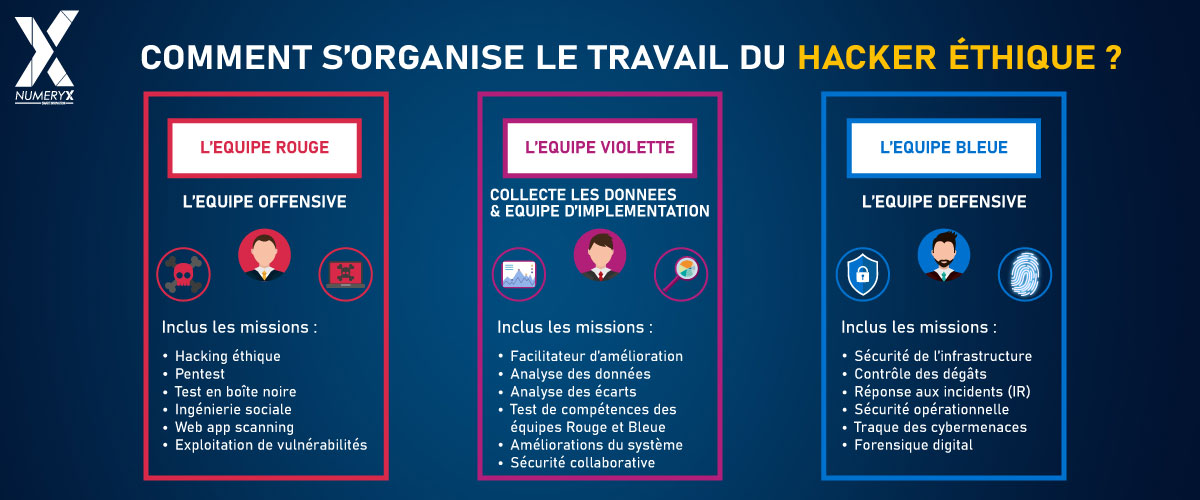
Among these ethical hackers, there are therefore different roles, and even different teams:
The Red Team, a team of penetration testers
The red team provides offensive security services by imitating the role of a cyber attacker.
It is common for this red team to be a team external to the organization that commissions them, in order to imitate as closely as possible an attack coming from outside, without prior knowledge of the security system in place. The types of attacks that can be carried out by the red team are numerous. They consist of exploiting “usual” vulnerabilities and more complex attacks such as social engineering, more commonly called Social Engineering, or psychological hacking.
The Blue Team, a team for improving defense
The blue team therefore provides defensive security services. Unlike the red team, the blue team is already informed of the defense system in place in the organization. It continuously analyzes unusual activities in the computerized system with security audit systems, log analysis or by drawing up risk scenarios.
It is work that requires enormous meticulousness, so as not to miss an unusual or foreign piece of code, for example.
The Purple Team, the union of Red Team and Blue Team
A combination of red and blue, the purple team identifies the teams that provide a part of each type of security service, red and blue. It is in reality joint work by the two teams and a cooperation aimed at strengthening knowledge of cyber attacks on the one hand, and of cyber defense on the other.
How to become an ethical hacker?
Historically, the ethical hacker was a self-taught person who acted alone and without having followed any particular training. The ethical hacker of yesterday was rather a Grey Hat Hacker, who acted for the good of one or more organizations by hacking their system without prior authorization and without an intrusion mandate, but informing the organization concerned of the existing security flaws in their information system or network.
In the United States, it is common for self-taught hackers who claim to be White Hat to be hired, after resolving bugs via bug bounty platforms, by the companies victim of these “bugs” that present security flaws in their computerized system. This is the case, for example, for companies like Facebook or Google.
In France, ethical hackers are for the most part already information systems experts or network security experts. They are very often trained in cybersecurity and made aware of cybercrime in a second stage. It is therefore in the vast majority of cases a career progression rather than a change of function.
The script kiddie, or the definition of an amateur hacker

Not everyone can be an ethical hacker! The script kiddie (in French “gamin à script”), also called a lamer (meaning “weak” or “lame” in English), is a pejorative term that designates computing neophytes who try by any means to infiltrate systems, while lacking IT security skills.
The script kiddie is the type of profile who uses simple programs, or even ones already designed by experienced hackers, but which they do not understand, and who claim large-scale attacks to give themselves legitimacy.
Despite their low level of qualification, script kiddies can represent a real threat to the security of systems. On the one hand, because script kiddies are very numerous, and on the other, because they are often very obstinate in carrying out their action, to the point of sometimes spending several days trying several different attacks to succeed.
However, with their lack of knowledge and skills, script kiddies take few precautions when they act. They make fairly basic mistakes that make them easy to identify, and therefore to hack.
Today, the starting point for becoming an ethical hacker is above all training, and it can be reinforced by obtaining one or more certifications.
What training to follow to become an ethical hacker?
What training to follow to become an ethical hacker?
To become an ethical hacker, one logically needs a good level in IT, and also a specialization in cybersecurity.
For this, it is possible to follow a training at a Bac +3 level, or to continue up to Bac +5, and beyond.

It is possible to follow this type of training at university, in an engineering school or in a specialized school by choosing a cybersecurity track.
Subsequently, it is entirely possible to become an independent ethical hacker, or to be part of an organization.
What certifications to become an Ethical Hacker?
Indeed, there are certifications specific to ethical hacking. Two of the most famous worldwide are the CEH – Certified Ethical Hacker certification and the OSCP – Offensive Security Certified Professional certification.
- The Certified Ethical Hacker (CEH) certification
This CEH certification was recently revised to offer a complete and updated 11th version.
Recognized worldwide by security professionals and compliant with the ANSI 17024 standard, the CEH certification is real added value for your CV and your career in the world of cybersecurity, penetration testing and more particularly in the world of ethical hacking.
This training ends with an exam which is a multiple-choice questionnaire lasting 4 hours.
- The Offensive Security Certified Professional (OSCP) certification
The OSCP certification is designed to demonstrate the skills and knowledge needed to be a penetration tester. This certification is therefore made for you if you wish to build your career in cybersecurity.
If you want to learn more about defensive and offensive techniques in penetration testing, then you should consider obtaining the Offensive Security Certified Professional (OSCP) certification.
Unlike the CEH certification, the OSCP is not a multiple-choice exam. Here you have to put your knowledge into practice with a remote LAB, which will assess your technical skills as well as the quality of your reporting.
Interested in cybersecurity training or certification?
Go to the “Cybersecurity ” section of Numeryx University to discover 13 cybersecurity courses, on-site or remote
What are the missions of the ethical hacker?
The ethical hacker bypasses the security rules of the organization that commissioned him. He organizes a cyber attack or a series of attacks, in order to detect breaches in the organization’s information system, then notifies them to the organization so that it can then remedy them.
Within his scope, the ethical hacker will not only perform vulnerability tests (the Pentester’s activity), but will also carry out other work, the main items of which are the following:
Penetration and regression tests
There is indeed a battery of tests to carry out, including those mentioned in the following non-exhaustive list:
- External network penetration tests,
- Internal network penetration tests,
- Web application penetration tests,
- Mobile application penetration tests,
- Wireless network penetration tests,
- Regression tests,
- Tests of embedded devices,

Identification of security misconfigurations
To reduce the risks of attacks on their network, companies are required to follow security rules according to their sector of activity, and as far as possible, to apply them.
However, it is not uncommon for these procedures not to be correctly applied, which gives malicious hackers opportunities to spot security flaws and exploit them. In the crosshairs, there is the loss of sensitive and/or strategic data by theft, by deletion or by making it inaccessible via ransomware, and many other threats. Ethical hackers must therefore check whether these security measures are properly observed, by taking stock:
- Is there encryption of documents and directories?
- Misconfigured web applications, unsecured devices?
- Is the retention of default credentials still in place and systematic?
- Does the use of weak passwords persist?
It may seem basic, and yet, these few points cited above are very widespread cases in the business world and account for a large number of IT security breaches, all as simple to solve as they are dangerous for an organization.
Setting up vulnerability scans
The first step for the ethical hacker will be to map all of the company’s networks, with a view to ranking them by importance. This network mapping is a necessity to discover new devices and new network interfaces, to visualize the connectivity of the physical network and that of the virtual network.
Network mapping therefore offers full visibility of a company’s IT infrastructure to identify which parts of this network to secure first, according to the value and volume of information.
As for vulnerability scans, they allow companies to check the compliance of their networks and security systems. Vulnerability analysis tools will precisely locate the security flaws that may be dangerous for the systems in the event of an attack.
Preventing the exposure of sensitive data
In the event of loss of sensitive or confidential data, companies are exposed to financial penalties for failure to respect privacy in addition to the loss of revenue caused by these data losses, in addition to the other harm it causes them (loss of trust of customers and end users, shareholders, etc.).
To protect against this possible loss of sensitive data, ethical hackers carry out penetration tests in order to identify these types of flaws, to determine the vulnerabilities of the information system, and to document the modus operandi of possible attacks.
Checking authentication flaws
By compromising the authentication of an organization’s website, attackers can retrieve a lot of data such as passwords, cookies, or information linked to user accounts. This information can later be used by them to assume the false identity of employees, or to access more sensitive or even confidential levels of information.
The ethical hacker’s mission in this case is to check the management of authentication systems, and to suggest security measures to put in place in order to protect the organization.
There are of course many other missions for the ethical hacker, such as:
- Assessments of mainframe systems or applications,
- Assessment of the application security program,
- Security code review.
You may be wondering what the pay level of an ethical hacker is for all these good and loyal services?
What is the salary of an ethical hacker?
On average, a beginner ethical hacker working in France will earn 4,000 euros gross per month against 7,500 euros gross for a senior profile. More and more professionals are also paid in the form of rewards for resolving a bug thanks to bug bounty platforms.
What is the difference between a Black Hat Hacker and a White Hat Hacker?
If the border can be thin on the technical level, it is immense on the moral level!
The white hat hacker, called an ethical hacker, is, as its name indicates, on the right side of the fence.
He acts only with the knowledge of an organization that has commissioned him to test the vulnerability of its computer system, in order to report on it and take effective measures to strengthen this computerized system and remedy the flaws that will have been detected. These penetration tests and methods will therefore not aim to harm the organization, but solely to strengthen it.
The Black Hat Hacker does not ask anyone’s permission to break into a computerized system. He intends to harm, destroy or steal data.
Finally, as not everything is all white or all black, there is a profile straddling these two worlds called the Grey Hat Hacker. He can break into a system without warning and look for flaws without having received permission beforehand, like a black hat, but with the difference that he can then report the security defects to the hacked organization (for a certain sum of money, or not).


