

This article was written on 05/31/2023 and reviewed on 03/04/2024. It may contain some non-exhaustive information depending on the rapid evolution of Chat-GPT by OpenAI. It will therefore be reviewed several times in order to stay up to date.
As coding or programming can now be done with an LLM (Large Language Model) tool and generative AI, many professions are threatened in the medium term. The web developer profession is one of them. How can one avoid succumbing to the temptation of replacing a team of devs when a single person will be able to code with Chat GPT?
Artificial intelligence has been making considerable progress for several decades, to the point that many professions could disappear in the near future. The arrival of Low Code and NoCode had already been a first earthquake in the world of web development. Generative AI now looks like a real tsunami.
What will become of development teams when a single person who knows how to handle generative AI perfectly is enough to code websites or applications?
I] Chat GPT, the Generative AI tool that could make the developer profession disappear
Generative AI is progressing so fast that the professional landscape may no longer be the one we currently know. With Chat GPT, it is possible to debug code, detect security flaws, code, develop in several programming languages, simulate a virtual machine, build web pages, develop applications…
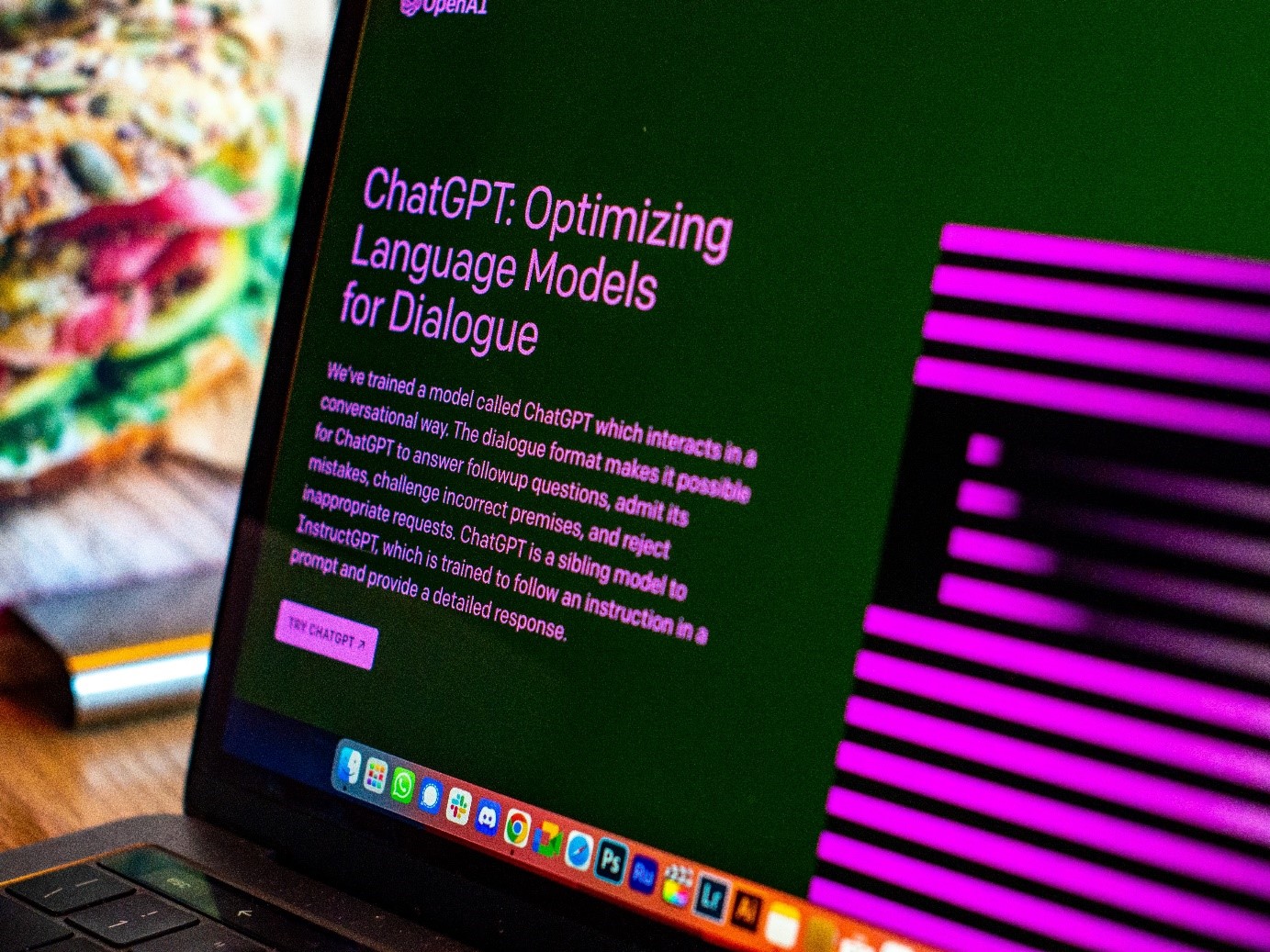
One may then wonder, what is the place of a web developer when a free, open source tool can do everything in their place?
1. Chat GPT makes it possible to generate code without real web development knowledge.
It is a conversational tool capable of generating code very quickly, and of developing a program in any programming language. It is perfectly suited to creating relatively simple development building blocks, as long as it is given a well-framed prompt. As it is a chatbot, almost everyone understands how they work, so it is within everyone’s reach to be able to use it.
2. Chat GPT can be used to create a website or a mobile application
With a well-framed prompt, Chat GPT can be pushed to go even further. Examples are blooming on the net, and it is no longer a secret, Chat GPT can code in JAVA, in HTML/CSS or in Python using an OpenAI API key.
However, it is rare for the first copy to be perfectly finished. Nevertheless, it is entirely possible to rework it without being a web developer. It is even possible to ask it to review code in case of a technical incident. It is also possible to ask it to rephrase its answers as many times as necessary. In the end, you can have the luxury of choosing between several versions of generated code, without having any specific knowledge of coding or programming.

Regarding web or mobile application development, it is entirely possible to use Chat GPT by plugging it into other APIs to create more sophisticated applications. By installing, for example, the WebChatGPT plugin on your browser, you can obtain search results that take current events into account, and therefore current coding techniques, without being stuck in the year 2021 as was the case before.
These improvements are regularly made by OpenAI and are even crucial for this tool to remain the reference among LLMs (Large Language Models) and generative AI.
Open AI has also developed another application for generating images from a prompt called DALL-E 3, an alternative to another famous AI: MidJourney. By combining the two AIs, which are now compatible (Chat-GPT and DALL-E 3), you can therefore create code, text and images for your projects, without specific knowledge of copywriting, coding and graphic design.
3. Developers have limited knowledge, Chat GPT does not
Although developers have strong knowledge of coding and programming, they are not comparable to an LLM-type language model.
This technology is trained on vast sets of data and texts. It takes in millions and millions of data points every day to refine the answers to the queries addressed to it.
This represents billions of words and combinations. Thus, Chat GPT was able to learn statistical models of language to answer the questions it is asked in the most human and precise way possible.
This is one of the reasons why Chat GPT can answer questions related to coding or programming, and do so in many programming languages if not all, which can sometimes demand more knowledge from a web developer who does not master them all in their work.
4. Chat GPT has a computing power and speed of execution that humans cannot match
Its ability to retrieve information, added to its ability to rephrase and then deliver answers, is unmatched by humans.
Besides the fact that Chat GPT can answer questions in the most human and structured way possible to the queries addressed to it, its ability to find an answer on every existing subject is superhuman.
It takes it no more than a minute to answer, more or less precisely, any question on any subject. Its knowledge base is not quite “infinite”, but the field of possibilities already seems to be for this AI, especially for GPT4 which already far outclasses GPT3.
For information, Chat GPT 3 takes into account 175 billion parameters.
Behind all this, there is Microsoft, with an initial investment of one billion dollars in 2020 in the company OpenAI, essentially to build from scratch a world-class supercomputer, and with the aim of giving it the computing power needed for its creation and training.
Also, the Azure foundation of the American giant will give OpenAI a solid base to develop and manage to launch GPT4.
In 2023, the famous media outlet Bloomberg announced that Microsoft will very soon invest 10 billion dollars in OpenAI to accelerate its AI work.
II] Chat GPT is on the verge of a technological revolution, but…
LLMs like Chat GPT are multiplying, but face a few technical, legal and ethical problems. Here are some avenues for you to understand what its main areas for improvement are:
1. A framework must be set to guarantee virtuous data processing.
LLMs can indeed have consequences for the confidentiality and security of sensitive information such as medical secrecy, industrial secrecy and government secrecy. Given that these models have the ability to generate texts that can be very convincing, they could potentially override the limits of confidentiality and security.
This can be done by limiting access to these models and by applying rules and regulations for their use, in particular for government organizations and companies. Researchers and developers of LLMs also have the responsibility to take into account the ethical implications of their work and to ensure that these models are used responsibly.
2. Chat-GPT exploits the internet as a whole, with its flaws, to provide the most “probable” answers
LLMs like Chat GPT can reproduce existing biases in the data they are trained on, which can potentially harm groups of people who are marginalized or discriminated against in society.
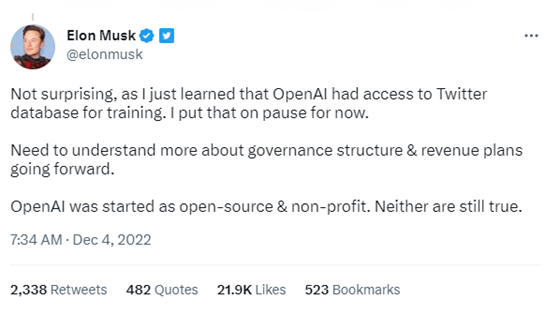
For example, it turned out that Chat GPT drew information from Twitter, in particular by taking into account the comments of any internet user replying to tweets, and thus picking up all the excesses that we can find on social networks, as Elon Musk revealed in a tweet.
We will later find this same Elon Musk, together with hundreds of world experts such as Apple co-founder Steve Wozniak, who recently signed a letter from the Future of Life Institute calling for a six-month pause in research on artificial intelligences more powerful than Chat-GPT 4, OpenAI’s model, to prevent “major risks for humanity“. Perhaps a way of buying time in order to develop his own LLM project initially named TruthGPT, then xAI and its chat named Grok ?
Elon Musk, a former member of OpenAI, now seems to be in complete disagreement with the direction of the company that founded ChatGPT, since Elon Musk recently filed a lawsuit against Sam Altman.
This lawsuit concerns the fact that the origin of the company he was part of was supposed to be only a non-profit research organization to advance science with the help of AI for all internet users, and not a company aiming to get rich, by getting closer to Microsoft…
The growing concerns about AI and LLMs have also produced the first notable reactions such as the resignation of Geoffrey Hinton, a pioneer of artificial intelligence research at Google.
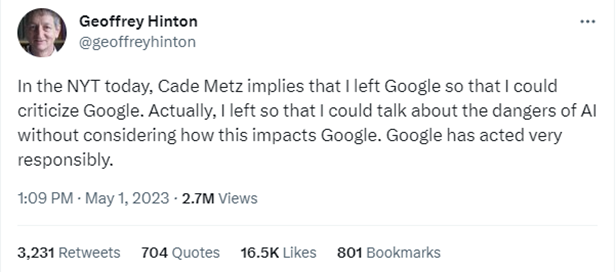
He confided to The New York Times that he was worried about the turn AI is taking in today’s world and in tomorrow’s world.
He confides during this same interview published on May 1, 2023, that “future versions of this innovation could be a risk to humanity“. He finally confesses that he “regrets his contribution to this innovative field“.
The day after this interview, he said in a new interview given to the BBC that “chatbots are scary” and then declared of these chatbots that “right now, they are not more intelligent than us, as far as I can tell. But I think they soon will be.”
These LLM models are today sparking debates on the ethical and social implications of automating the production of text, and therefore of code, and more broadly, on how we should use this technology. As an AI is not bound by professional secrecy, the question of Ethical AI arises very seriously.
3. Chat GPT facing industrial, medical and government secrets
LLMs can have consequences for the confidentiality and security of sensitive information such as medical secrecy, industrial secrecy and government secrecy. These models have the ability to generate texts that can be very convincing. They could potentially override the limits of confidentiality and security of all organizations..
An LLM could be used to generate fake medical reports or to access confidential industrial information. Samsung paid the price, using the Chat-GPT platform to correct source code for one of its applications while revealing confidential information to it, following the revelations made by the famous Korean media outlet Economist
Machine Learning therefore took this information into account in its learning as new variables that can be returned to anyone who comes looking for the information. Samsung therefore blocked the use of Chat-GPT in its workplaces, fearing leaks of confidential information. This situation also concerns other large companies such as Verizon or JP Morgan.
In the government domain, an LLM could be used to bypass security protocols and access classified information or to spread disinformation via social media.
To deal with these risks, it is important to have strict security protocols in place to limit access to these models and to the information they contain. Government organizations and companies may also need to strengthen their cybersecurity to protect themselves against potential threats linked to LLMs.
Regarding professional secrecy, the weakness that exists for companies has the same origin as in the world of cybersecurity, and comes from human intervention. According to a study conducted by Cyberhaven, 11% of the data that employees paste into Chat-GPT is confidential.
A mid-sized company (ETI) would therefore disclose confidential information to Chat-GPT hundreds of times a week, the problem being that Chat-GPT incorporates this material into its knowledge base, which then becomes accessible to the general public.
4. Diverted uses of Chat GPT allow hackers to develop malware
As revolutionary as this technology is, generative AI is only in its infancy. Yet, it did not take hackers long to divert the use of Chat-GPT to create malware.
In the Chat-GPT 3 version, the ethical code defined by Open AI did not properly counter hackers’ social engineering techniques. When Chat-GPT was asked directly to hack or to submit hacking techniques to it, the AI replied that it could not serve as an answer for this type of use. But, through repeated questions and requests, Chat-GPT 3 did end up providing pieces of code that then allowed cyber hackers to create Trojan horses, or parts of code to set up phishing.
5. What difference between human intelligence and artificial intelligence?
“We are biological systems and these are digital systems.” said Geoffrey Hinton about AI and chatbots.
Despite the immensity of the data taken into account by Chat-GPT, artificial intelligence still has many gaps compared with human intelligence. Indeed, it reproduces certain biases that are present in the data it retrieves from the net and in the data it has assimilated.
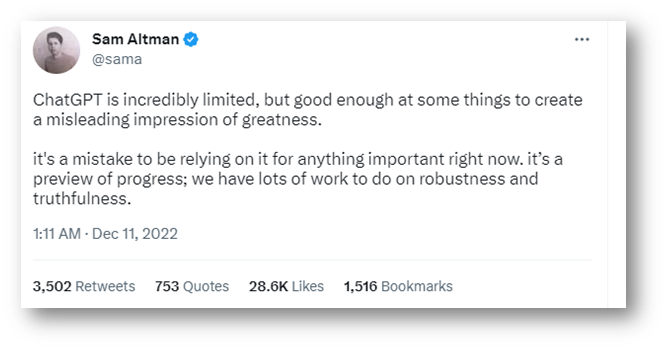
Sam Altman, the founder of Open AI, also revealed in a tweet published in December 2022 that Chat-GPT was limited, thus taking precautions regarding the accuracy of the information delivered by the chatbot.
These limits are found in mathematics exercises, or in medical subjects leading the machine to make very serious errors if it found itself making a decision in place of a human.
The main difference therefore lies in emotional intelligence. The absence of critical thinking, the absence of sensitivity or of prioritization of information is what it lacks.
If you spoke about your expertise, and a novice spoke about it right after, Chat-GPT would average your two writings to offer a version that can satisfy everyone. The result will therefore not be up to the mark.
The latest Chat-GPT updates regarding mathematics seem to show that the subject is being taken seriously, since fixes have been made so that the AI makes fewer errors. This is also the case for understanding the Python language (Read release notes February 13, 2024),
There are therefore many parameters for which Chat-GPT cannot replace a “real” professional, such as a web developer. A novice could indeed produce code thanks to Chat-GPT, but without knowing what they are producing, they could not adjust it to a company’s precise need. Although Chat-GPT4 gets stronger a little every day thanks to the knowledge accumulated by internet users, and through its human training, there remain inaccuracies that do not “yet” put professionals out of the game.
III] Pair programming: Chat-GPT is a tool to help developers
If Chat-GPT does not steal the show from development and programming experts, it is an excellent asset to help them in their work. Automation of the most redundant tasks, code review, generation of code that can be modified at the margin to meet simple developments. And all this in several programming languages.
We are then talking about a pair programming tool, like a human-machine pair who both work to carry out a task or a set of tasks as work partners.
1. Chat GPT can generate code, but its quality depends on the type of programming language, and the complexity of the task.
Chat-GPT is an AI-based language model and can be trained on a large quantity of textual data, including source code. This means it can generate code from input texts, but the quality of the generated code can vary depending on the complexity of the task and the quality of the training data.
However, using Chat-GPT to generate code is intended for advanced users with in-depth knowledge of programming. It is important to understand that the generated code may require adjustments and modifications to ensure it is efficient and works correctly. It is therefore advisable to use Chat-GPT to generate code only as a starting point for programming projects, and not as a final solution.
2. How can Chat-GPT be used to solve cybersecurity problems?
If Chat GPT can serve hackers in creating their malware, or in social engineering, it can also serve honest causes, as can be the case in cybersecurity.
As Chat-GPT continuously compiles information, it integrates, like hackers, a certain history of the web’s cyber threats. This means it can learn from this historical data to identify suspicious behaviors and threats on the web. It can also be used to get a partial or complete answer to questions from internet users or employees about digital security.
Once properly framed, it can detect spam and identify malicious links in your e-mails or in your messaging.
It is therefore possible to use Chat-GPT as a starting point for identifying known vulnerabilities, in order to propose security measures to protect against them. From the cyber threats studied and countered in the past, Chat-GPT is therefore able to provide leads, also known, to guard against certain dangers in your network, or more broadly, in your organization.
3. Chat-GPT is not (yet) suited to specific environments
To date, the most technical and specific environments cannot be mastered by Chat-GPT. While Chat-GPT can rely on what exists, it cannot create new development techniques, new programming languages, and create expertise from scratch in place of humans. By relying only on what exists, Chat-GPT is also a brake for hackers, who will not be able to use Chat-GPT technology to create malware that does not yet exist on the web.
4. Chat-GPT and its ethical limits
While it is possible to ask Chat-GPT to imitate the writing style of a company or a human being, Chat-GPT cannot substitute for a legal entity or a natural person, for lack of sensitivity or for lack of personalization. When we talk about “code”, this time, we are talking about codes of conduct, ethical codes, and behavior. A developer will therefore have to rework code generated via Chat-GPT to adjust and adapt it to a company’s codes, with its style, its jargon, its expertise and its critical thinking, but also with its regulatory and legal environment.
It is also for this reason that Bard, Google’s Generative AI, or Claude 2, another generative AI, are still banned in France and in several other countries. Because it does not take into account the specificities and regulatory constraints of each country case by case to ensure a service perfectly framed by the national legislation specific to each country.
For a 100% frenchy generative AI with performance equivalent to the best American generative AI models, you can turn to “LeChat”, the model by MistralAI.
5. Reinforcement Learning, or AI trained by humans
Chat-GPT stands for “Chat Generative Pre-trained Transformer”, which can be translated as “conversation” and “pre-trained generative transformer”.
This tool is trained by supervised learning techniques and reinforcement learning, two approaches that use data created by humans to train the model with the aim of providing the most suitable answers possible to the queries given to it. With the consideration of billions of pieces of information taken from the net but also books of all kinds, Chat GPT also uses the users’ own queries to learn and provide ever more suitable answers. Users therefore contribute to training Chat-GPT continuously.
Conclusion
Chat-GPT is a fantastic tool that will allow developers to save time by automating the most redundant tasks, and by serving as an assistant in code generation as well as in code verification. Nevertheless, Chat-GPT is not yet able to customize code generation as an “in-house” developer could. Human intervention is necessary so that your code is not generic code, but really that of your organization.
Even if framing prompts are well executed, and you ask it to put itself in the shoes of a typical organization, Chat-GPT has technical limits.
These limits therefore do not allow it to fetch information offline or hosted elsewhere than on the net., It is therefore not able to code specifically on unique and personalized projects for your organization or for your client. As Chat-GPT relies on what exists, it does not yet have predictive capability, nor the ability to create code that has never been developed before.
This is also why hackers have a limited malware-creation power with this tool. Developers therefore have every interest in using Chat-GPT as an assistant, relying on its computing and analysis power. Nevertheless, Chat-GPT in its current form is clearly not able to replace them. As long as Chat-GPT remains only a conversational tool, a developer must in any case interact with it, and play the role of controlling what is produced by the AI.
Developers still remain indispensable today for the creation of unique and quality software, but can perfectly well use generative AI such as Chat-GPT or GitHub Copilot Chat to help them in their daily work.


