
In a context of increasingly fierce competition, companies are seeking to stand out by adopting effective management that focuses on people. Many of them are turning to Agility and Scrum which defines roles that increase the value chain. Among these roles is that of the Product Owner (PO).
Beyond its theoretical description in the Scrum Guide, the PO’s stance has still not gained unanimous support, to the point of being likened to a passing trend. This leads us to wonder what means allow the Product Owner to be a strategic vector of continuous improvement.
Presentation of the Product Owner profession
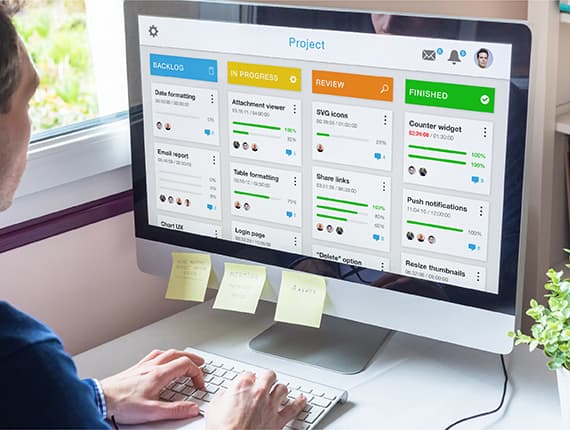
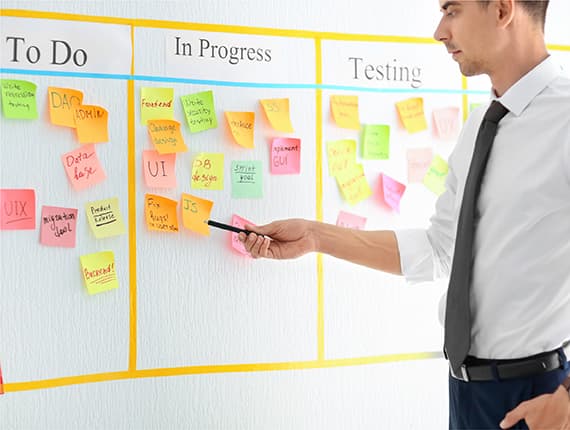
First of all, note that in theory, the PO is a member of the SCRUM team. They are responsible for gathering all of the customer’s needs and translating them into what is called a team Backlog so that the project team can deliver them.
Their art consists of streamlining the execution of the program’s priorities while maintaining the conceptual and technical integrity of the features or components for the team. Their ultimate goal is to deliver value, while keeping the product alive over time.
The PO must always keep in mind the final value the product brings to users. This requires a certain perspective on the product as well as support from key stakeholders. Without this shared understanding, the PO role can create confusion and be mistaken for other related roles such as that of Product Manager, for example. The latter’s role is to analyze the market in order to draw up a strategic roadmap around the product. The PO must in fact rely on and draw inspiration from this strategy to bring the business and technical worlds together around a product vision in order to increase the business value generated. Everything is done in an iterative and incremental approach allowing them to adjust course if needed.
The two roles coexist and are complementary as long as the perception of these roles does not hold the PO back.
Obstacles preventing the Product Owner from generating value
In certain situations, the role of a PO is compromised:
- If needs are known in advance and are unlikely to change, or if tasks cannot be divided and planned so as to deliver increments every sprint, then the nature of the project does not require a PO. Appointing a Product Owner is in this case likely to follow a trend.
- In certain projects or organization charts, the PO position is designed to act as a go-between between the customer (Business) and the development team. This certainly holds back the PO’s role as a value chain optimizer.
- Confusion around their role: if the PO has no room for maneuver over the product, or if they are there only to smooth exchanges between teams, then the PO does not hold a product vision that “belongs” to them. In this case, a RACI matrix is needed to identify expectations and cross-check them against the PO role as defined in SCRUM. The team or organization can then decide on their usefulness within the team.
- A lack of communication with the customer generates a lack of information that then affects the team’s work. This results in a gap between the product increment and the customer’s expectations, and thus a loss of value, whereas, let us remember, a PO must carry value for the product and the company.

Product Owner tools to enhance the product
The PO must optimize the quality of deliverables, motivate the team and satisfy the customer.
To achieve this, their environment must be part of an overall Agile approach that gives the PO the necessary room for maneuver which, together with the right tools, will allow them to be at the heart of the company’s strategic improvement.
To take on this role, the PO must have the right posture. They must think product rather than production through a clearly defined vision and effective communication.
- The PO must equip themselves with a good range of key indicators to measure the impact of certain decisions and the gaps with respect to their product vision, and finally make the necessary trade-offs.
- Technological and methodological monitoring is necessary to fight resistance to change within the organization.
- Choose the right granularity for breaking down the need or the solution in order to increase the value of an increment.
- Provoke change, be a lever for continuous improvement: the PO’s proactivity and ability to make proposals will deepen stakeholders’ trust in their product vision.
- Share the backlog content transparently with the organization. This facilitates negotiations with other stakeholders, if needed
The role of the PO depends on the organizational and technical maturity of the team and the organization. This implies the importance of factors such as project complexity and expertise in Agile practices. Thus stakeholders support the PO by giving them the necessary room for maneuver to act on the product while carrying a strategic vision through which the company can meet market requirements and customer expectations.